What is an AI Agent? A Plain-English Guide for Developers and Non-Technical Founders
AI agents are software that can reason, decide, and act — without someone pressing a button each time. Here’s what that means in plain English, with real examples from NGO and government deployments.
Last year I was brought in to look at a reporting process for a health project. Every Monday morning, one of the programme officers would spend the first two hours of her day pulling numbers from three different systems, dropping them into a spreadsheet, and emailing a summary to the district team. She’d been doing it for eighteen months. Nobody had questioned whether it needed a human.
An AI agent now does that entire process. It runs at 6 a.m., before she’s even at her desk. She only hears from it when something is off.
That’s what an AI agent is — software that can read information, decide what matters, and act on it, without waiting to be told each time. This article explains how it actually works, when it’s the right tool, and when it isn’t.
You give it a goal. It figures out the steps. It does them.
That’s it. The word “agent” just means it acts on your behalf, the same way a travel agent books your flights so you don’t have to research every option yourself. The “AI” part means it can handle situations that aren’t perfectly predictable — ones where the answer isn’t always the same, and where a bit of judgment is required.
How is This Different From a Chatbot or Regular Automation?
This is where most explanations get muddled, so let’s be precise.
- A Chatbot (Reactive): Waits for you to say something, responds, and stops. It reacts to you. It doesn’t go off and do things while you’re asleep. ChatGPT is a chatbot — a very capable one, but still a chatbot. You prompt it, it answers, done.
- Regular Automation (Rigid): A scheduled script or a standard workflow (like a basic Zapier setup) follows a fixed set of rules defined in advance. If this happens, do that. Every time, exactly the same way. It’s powerful, but it breaks the moment it hits something unexpected. If a website changes its layout, your scraper breaks. If an email arrives in a weird format, the workflow falls apart.
- An AI Agent (Autonomous & Adaptive): Combines both. It can respond to novel situations like a chatbot, but it also goes out and acts in the world like an automation. It can browse a website, read what’s there today, decide whether that information is relevant to your goal, and then either send you a summary or take the next step — all without you being in the loop.
The Practical Difference: A regular automation runs a fixed train route. An AI agent navigates like a driver using GPS.
For Developers: Under the Hood
Instead of a rigid rule engine built on if/else logic, an agent uses a Large Language Model (LLM) as its reasoning engine.
The LLM interprets the current state, decides which tool to call next, and processes the result before deciding what to do again. This loop — observe, reason, act, observe again — is known as the ReAct pattern (Reasoning + Acting). The agent isn’t following a static script; it’s dynamically generating its next step based on context.
The 3 Things Every AI Agent Needs
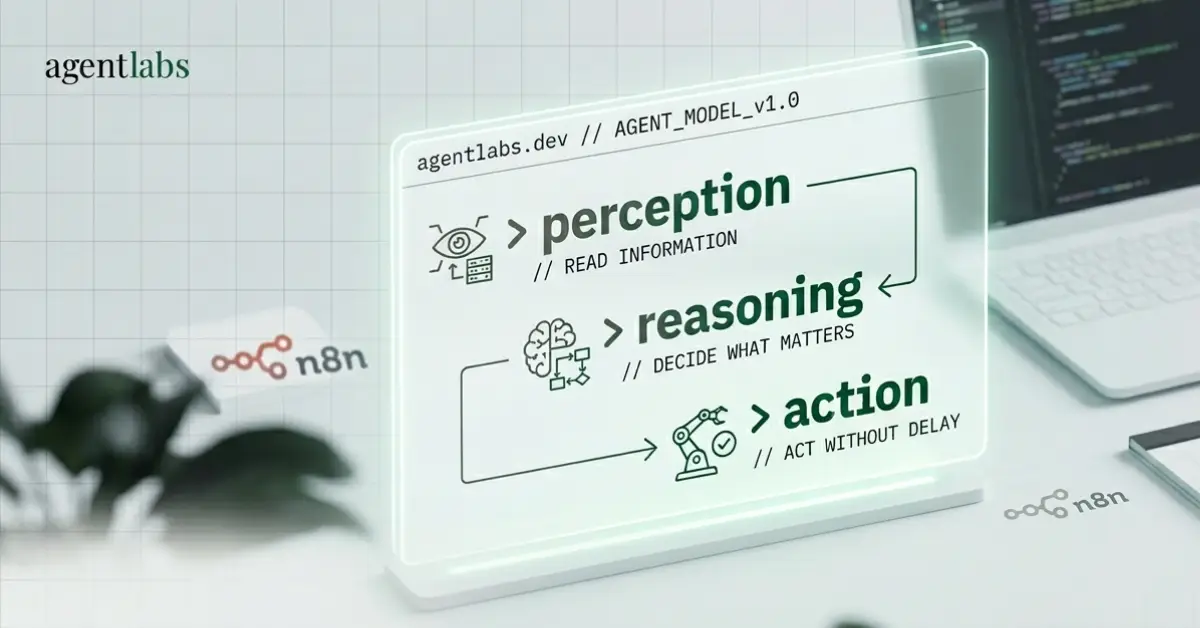
Every agent, no matter how simple or complex, executes a continuous three-step loop:
- Perception (It reads): It ingests data from an email, a database, a webpage, a file, or an API response. This is how it establishes situational awareness.
- Reasoning (It decides): It determines what to do next. Not by matching a hardcoded rule, but by applying judgment: Is this data relevant? Does this match my goal? What is the logical next step?
- Action (It executes): It interacts with the outside world. It sends an email, updates a spreadsheet, calls an API, creates a ticket, or triggers another workflow.
Then it loops back to perception and does it again, until the goal is complete or it hits an exception that requires a human hand-off.
A Real-World Example
I recently built an agent tasked with monitoring district health data from 12 clinics across Malawi:
- Perception: Every morning, it pulled the latest figures from a central system.
- Reasoning: It checked whether any indicator had dropped below thresholds set by the Ministry of Health.
- Action: If a metric plummeted, it autonomously sent a WhatsApp alert directly to the District Health Officer with the specific clinic name and metric.
Nobody had to press a button. Nobody had to remember to check. The right person got critical information at the right time.
For Developers: Tool Use
The “Reasoning” step is where the LLM lives. The model receives a prompt containing the core goal, the system prompts (guardrails), a memory history, and the output of its last action. It then selects the appropriate tool to call (e.g., a web search function, database query, or HTTP request).
The tools themselves are just standard code functions. The intelligence lies entirely in the LLM’s ability to choose which function to call, in what order, and with what parameters.
What AI Agents Are Actually Being Used For
Concrete use cases ground this technology better than any abstract definition:
Department / Sector | What the AI Agent Does |
Business Operations | Monitors procurement portals for new tenders matching a company profile, extracts deadlines/requirements, and drafts a daily morning summary for the BD team. |
Customer Support | Reads incoming emails, classifies them by issue type, fetches answers from an internal knowledge base, and drafts a personalized reply for a human to review—cutting response times by 70%. |
Data & Reporting | Pulls data from multiple sources on a schedule, cross-references them, flags discrepancies, and delivers a pre-built summary report straight to a Slack channel. |
NGOs & Government | Tracks shipments of medical supplies across districts, reconciles delivery confirmations with expected quantities, and raises system alerts when discrepancies cross a specific threshold. |
These aren’t futuristic concepts. They are running today, built with tools that are either free, open-source, or cost less than a cup of coffee to run.
What AI Agents Are NOT Good At
Most articles skip this part, but knowing where agents fail is the most valuable insight you can have.
- Tasks requiring 100% mathematical or logical perfection: LLMs reason probabilistically, not deterministically. They are phenomenal at judgment under uncertainty, but unreliable for tasks where a minor calculation error causes catastrophic damage (e.g., automated legal decisions or raw financial accounting). Use agents to assist, flag, and draft; keep humans in the loop to approve.
- Highly volatile environments: If a website changes its backend layout weekly, or if your source data has absolutely no consistent structure, an agent will eventually hallucinate or fail silently. They require reasonably stable operational boundaries to remain reliable.
- Simple, predictable tasks: If you can write the rules using simple logic and the task never changes, an agent is massive overkill. A regular automation is faster, cheaper, and 100% reliable. Don’t use an agent to send a birthday email at 9 a.m. everyday. Use an agent when the task requires contextual judgment.
The Takeaway: Agents are not magic. They are mirrors of the infrastructure you give them. A poorly designed agent makes confident mistakes; a well-designed agent saves thousands of human hours.
Where to Start
If you are a Developer:
The lowest-friction starting point is n8n—an open-source workflow tool that lets you visually wire together an LLM, customized tools, and triggers without drowning in boilerplate code.
- Start by building a simple project, like a free AI news digest agent.
- Once you master the basic perception-reasoning-action loop, transition to frameworks like CrewAI or LangGraph to build complex, multi-agent systems.
If you are a Founder or Manager:
Don’t worry about the code. The most useful thing you can do right now is grab a notebook and map your team’s workflows:
- Find the most repetitive, time-consuming task someone does manually every week.
- Look for tasks that require reading information from one place and moving it to another based on basic guidelines.
That is your pilot project.
One Final Thought
The question isn’t whether AI agents will affect your sector. They are already doing it. Forward-thinking organizations are deploying agents to handle operations that used to require massive headcount, running them on infrastructure that costs less than a basic mobile data bundle per month.
The real question is simple: Will you build the agent that works for you, or will you wait to compete against someone who did?
Gomezgani Walumbe is a software engineer and AI consultant based in Lilongwe, Malawi. He builds AI agents, n8n automation systems, and data infrastructure for NGOs, governments, and international development organizations across the SADC region. Follow his work at AgentLabs or on YouTube.
